Claude AI Training in Bengaluru
(Bangalore): the complete guide
for businesses
What This Guide Covers
- 01Why Hitesh Motwani — not just any AI trainer
- 02Why Claude AI — not just any AI tool
- 03Why Bangalore is India's Claude AI capital
- 04Industries benefiting most in Bengaluru
- 05What a real training covers — 6 modules
- 06Real prompt examples for Indian enterprises
- 07Claude vs ChatGPT — honest comparison
- 08How to evaluate a Claude AI trainer
- 09What outcomes to expect & how to measure
- 10Frequently asked questions
Get in touch with our team for customised training of Claude AI in Bangalore
Fill up the above form if you wish to speak to Hitesh to take his training or consultancy services. He can help you with 1 to 1 coaching, corporate training and group coaching.
Why Hitesh Motwani — and not just any AI trainer
The AI training market in India exploded in 2025–26. With that growth came a wave of trainers running ahead of their experience — generic AI overview sessions repackaged with Claude screenshots, delivered by people who learned the tool last month. Hiring one of them is a real risk, and a real waste of your team’s time.
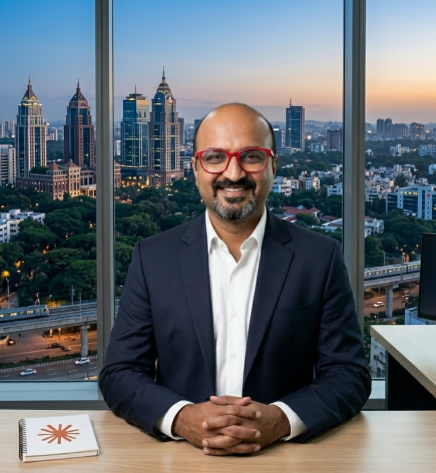
Hitesh Motwani is different. As Chief AI Officer at Skillopedia Group, he has spent years building genuine expertise inside Anthropic’s ecosystem — not just the chat interface, but the full Claude stack: Models (Haiku 4.5, Sonnet 4.6, Opus 4.6), Projects, Agent Skills, Connectors, Claude Code, and Agentic AI workflows. He is one of a very small number of trainers in India who can credibly teach all of it.
"Hitesh's training is not about Claude in theory. It's about Claude in your workflows, with your documents, mapped to your KPIs — from the first hour of the session."
His credentials are extraordinary even by national standards: Visiting Faculty at IIM Bangalore, IIM Lucknow, IIM Udaipur, SP Jain, and Symbiosis. He trained Google’s AI support team. He has delivered 200+ CMO Bootcamps and holds a 4.8★ average rating across his programmes. He is associated with upGrad, Simplilearn, and TimesPro, and has spoken at the Informa Middle East Summit, Tech Asia, and HR Summit Mumbai.
Hitesh Motwani — Credentials at a Glance
- Visiting Faculty — IIM Bangalore, IIM Lucknow, IIM Udaipur, SP Jain, Symbiosis
- Masters, Welingkar Institute | Digital Marketing Certification, IIM Bangalore
- International Speaker — Informa Middle East Summit, Tech Asia, HR Summit Mumbai
- Trained Google's AI support team | 200+ CMO Bootcamps | 4.8★ average rating
- Chief AI Officer, Skillopedia Group | Associated with upGrad, Simplilearn, TimesPro
- 600+ enterprises trained across BFSI, Pharma, FMCG, IT, and Manufacturing
Why Claude AI — and not just any AI tool
There are dozens of AI tools competing for attention in 2026. The first question any honest Claude AI training should answer is: why Claude specifically? Claude is built by Anthropic — a safety-focused AI company. It is designed to be reliably useful: less prone to hallucination on complex documents, more consistent across long conversations, and built with enterprise compliance as a first-class concern.
A note on model versions: As of 2026, Claude Sonnet 4.6 and Claude Opus 4.6 represent the current generation. Hitesh's training is always current — built for the live model family, never teaching outdated knowledge.
Constitutional AI Safety
200,000-Token Context Window
Full Enterprise Ecosystem
Structured, Predictable Outputs
Why Bangalore is India's Claude AI capital
Bangalore is not just a geography — it is a mindset. Anthropic established its Bengaluru engineering hub here, making Bangalore one of only a handful of cities globally with a direct Anthropic presence. India now accounts for 5.8% of global Claude.ai traffic — second only to the United States — and enterprise adoption has doubled in under six months.
The city is home to more than 4,000 technology companies, including Indian offices of Infosys, Wipro, TCS, Accenture, Google, Microsoft, Amazon, and hundreds of funded startups at every stage. This diversity creates exactly the rich training landscape where Hitesh’s industry-specific customisation — fintech sessions that look completely different from SaaS sessions — delivers disproportionate value versus any generic AI training programme.
Bangalore Locations Served for Onsite Claude AI Training
Industries Hitesh Trains in Bengaluru — and What Each Gains
Not every industry adopts AI at the same pace. Here is an honest breakdown of how different Bangalore industries are using Claude under Hitesh’s training, and where the investment pays off fastest. Every session is customised — a fintech programme looks nothing like a marketing agency programme.
Code review automation, RFP response writing, documentation generation, internal knowledge base Q&A, sprint planning summaries, and client communication drafts. IT services firms with 500+ employees see the fastest measurable returns. Hitesh’s sessions cover prompt engineering for technical outputs, custom instruction sets, and Claude Code integration for engineering departments.
- Code documentation — 3–5 hours saved per developer per week
- RFP response time reduced by 50% within 30 days
- Claude Code integration for engineering and DevOps teams
Financial report summarisation, RBI and SEBI circular analysis, credit memo drafting, compliance review support, and customer communication templates. Hitesh’s BFSI-specific modules are built around India’s regulatory context. His DPDP governance module is a standard inclusion for all BFSI sessions.
- RBI and SEBI circular analysis in minutes, not hours
- Two-day tasks reduced to two hours for finance teams
- DPDP-compliant AI usage policies built during the session
User research synthesis, PRD drafting, investor update writing, changelog generation, customer support response templates, and competitive analysis. A five-person product team with Hitesh’s training operates with the output velocity of a ten-person team.
- PRD and investor update writing time cut by 60%+
- 5-person team operates at 10-person team output velocity
- Breadth-first training covering product, marketing, and support
Brief writing, campaign concept development, long-form content, social media calendars, pitch decks, and creative feedback synthesis. Agencies managing multiple brand accounts see dramatic efficiency gains when teams use Claude as a creative collaborator — not just a text generator.
- 3–4x content output increases without headcount growth
- Campaign briefs to multi-platform adaptation in one session
- Brand voice consistency maintained at scale
Product description generation at scale, customer service automation, email marketing drafts, category copy, returns policy documentation, and seasonal campaign planning. ROI concentrates in marketing and customer operations teams.
- Product description generation at scale in minutes
- Customer service response templates built during training
- Email marketing and seasonal campaign planning automation
Clinical documentation support, patient communication templates, research summarisation, and internal knowledge management. Hitesh’s healthtech sessions always include detailed modules on what Claude should and should not be used for, responsible AI guardrails, hallucination mitigation, and DPDP compliance for patient data contexts.
- Clinical documentation support with strict guardrails
- Patient communication templates reviewed for safety
- DPDP compliance specific to health data contexts
What Hitesh's Claude AI Training Actually Covers — 6 Modules
This is not a slides-and-theory session. Every module involves live prompting on real exercises, not slide-watching. Six modules, fully customisable to your industry and team function. All participants leave with a prompt library and 30 days of post-training support.
Claude AI Fundamentals
How Claude differs from other LLMs. Context window mechanics. Model tiers: Haiku 4.5, Sonnet 4.6, Opus 4.6 — which to deploy when. Account setup for Teams and Enterprise.
- How Claude's Constitutional AI training changes its behaviour
- Claude Projects, Artifacts, and custom shared instructions
- What Claude will and won't do — and why that matters
Prompt Engineering That Works
Role–context–task–format–constraints framework. System prompts vs user prompts. Chaining prompts for multi-step tasks. Controlling output format on demand.
- Building industry-specific reusable prompt libraries
- Structured JSON, markdown, and report outputs
- Handling edge cases and refusals intelligently
Workflow Integration
Uploading and analysing documents — PDFs, spreadsheets, presentations. Claude Connectors for Gmail, Google Calendar, Google Drive. Connecting to n8n, Zapier, Make, and Slack.
- Claude Connectors for native Google Workspace integration
- Building simple Claude agents — no code required
- API integration patterns for developer teams
Claude Code for Engineering Teams
Claude Code reads entire codebases, edits files, runs commands, and integrates with IDEs and CI/CD pipelines — autonomously, across multiple files simultaneously.
- Navigate and understand full repositories
- Write, debug, test, refactor across multiple files
- GitHub Actions and CI/CD pipeline integration
Agentic AI — Live Workflow Build
Participants build a complete agentic Claude workflow that executes a real business process — built live, taken home immediately. Multi-agent systems for enterprise scale.
- Multi-step planning and tool orchestration
- Claude Cowork for operations and knowledge workers
- Multi-agent systems for parallel enterprise tasks
Responsible AI & DPDP Compliance
India’s Digital Personal Data Protection Act implications for AI tool usage. Data hygiene in prompts. Hallucination detection and verification habits. Internal AI usage policy creation.
- What data can and cannot go into Claude prompts
- Building internal AI usage policies for your organisation
- Audit trails and accountability frameworks for AI decisions
Real Claude AI Prompt Examples for Indian Enterprises
One of the clearest ways to understand the difference between basic AI usage and trained AI usage is to see actual prompts. These are the kinds of templates participants leave Hitesh’s sessions with — built specifically for the work Bangalore teams do every day.
For IT Services — RFP Response Summarisation
For Fintech — Regulatory Document Analysis
For Marketing Teams — Multi-Platform Campaign Brief
Claude vs ChatGPT for Enterprise — An Honest Comparison
This is the question every training participant asks, so it deserves a direct and honest answer rather than a promotional one. Both tools are genuinely excellent. The choice depends on your specific use case, your team’s existing stack, and your risk tolerance around data handling.
| Capability | Claude (Anthropic) | ChatGPT (OpenAI) |
|---|---|---|
| Context window | 200K tokens (Sonnet 4.6) | 128K tokens (GPT-4o) |
| Long document analysis | Stronger — less context loss at document edges | Good, degrades toward document end |
| Output consistency | More predictable structure across prompts | Creative variation can be feature or bug |
| Code generation | Excellent, especially code explanation | Marginally stronger for complex codegen |
| Safety & refusals | Constitutional AI — fewer unexpected outputs | Improved but more variable |
| Image generation | Not available | DALL-E integration available |
| India data compliance | Enterprise tier with granular data controls | Enterprise tier available |
| Agentic ecosystem | Claude Code + Cowork + Connectors + MCP | Assistants API + function calling |
The honest bottom line: For Bangalore IT services companies, fintech, and any team doing heavy document work, Claude is typically the stronger choice. For teams that need image generation or have deep existing ChatGPT integrations, a hybrid approach often makes sense. Hitesh will never tell you Claude is right for every single use case — and that honesty is one reason enterprises trust him.
How to Evaluate a Claude AI Trainer Before You Book
With AI training in high demand, the market now has many trainers selling Claude workshops who are, in practice, one step ahead of their participants. Here is a practical framework for evaluating any Claude AI trainer before you commit your team’s time and budget.
Questions to Ask Before Booking
- Can you show me a sample prompt library or training material? Serious trainers have artefacts to share.
- Have you worked with companies in our industry specifically? What were the use cases?
- How do you handle the DPDP Act in your training — is it a module or just a footnote?
- What version of Claude are you training on? Is the curriculum updated for the Claude 4 model family?
- Can you provide a reference from a corporate client in Bangalore, not just an individual participant?
- What is your post-training support structure? A one-day session with no follow-up delivers shallow results.
- How do you measure ROI? Do you help define metrics before training begins?
- Do you use Claude yourself, daily, for real work — or do you primarily teach about it?
Red Flags to Watch Out For
- Trainers who market "AI training" generically across ChatGPT, Claude, Gemini, Copilot as if they are interchangeable tools with the same curriculum
- Sessions that are primarily slides and theory with no hands-on prompt writing during the session itself
- No mention of DPDP, data handling, or responsible AI — training that ignores India's regulatory context is incomplete
- Curriculum that doesn't mention Claude's specific model tiers, context window, or Projects feature — signs of Claude 2-era knowledge
- Claims of "ChatGPT-level training" repurposed for Claude without visible evidence of Claude-specific expertise
What Outcomes to Expect — and How to Measure Them
The single biggest failure mode of AI training investments is the absence of measurement. A team attends a workshop, says ‘that was interesting,’ and returns to their desks without changing a single process. This happens when training is treated as an event rather than a behaviour change programme.
Hitesh sets measurable objectives before every session begins and checks against them at the 30-day mark. Here is what that looks like across different team types.
Measurable Outcomes by Team Function
Frequently Asked Questions About Hitesh Motwani's Claude AI Training in Bangalore
Everything you need to know before booking Hitesh Motwani for Claude AI training — answered directly, with no marketing fluff.
Ready to Bring Bangalore's Best Claude AI Training to Your Team?
Whether you need a half-day workshop for your marketing team, a full enterprise rollout for 200+ employees, or a CXO leadership session — the first step is a 30-minute discovery call. Hitesh will map your team’s workflows to a custom Claude AI programme before any session is scheduled.
Available onsite across Bangalore · Online across India · Response within 24 hours
WhatsApp us