Hyderabad · Teams & 1-to-1Bought Claude seats, but not seeing it in the work?
Claude AI training & course in Hyderabad, on your own work
A hands-on Claude course for Hyderabad teams and professionals, taught live by trainer Hitesh Motwani. You bring real reports, sheets, decks and code; you leave with workflows you use the next morning.
- Hands-on, on your own files — reports, decks, proposals, SOPs, code
- Two tracks — business users, and Claude Code, MCP & agents for tech teams
- Onsite across Hyderabad or live online — Skillopedia training certificate
Individuals: learn 1-to-1 with Hitesh, scheduled around your work. Book a free call →
200,000+
16+
4.8★

 AuthorGenerative AI 360°
Teams trained at
The short answer
What is this Claude AI course, and who runs it?
It is live, hands-on Claude training in Hyderabad, run by Hitesh Motwani. Companies book it as a private programme for their team, onsite in HITEC City, Gachibowli, the Financial District or anywhere in the city, or live online. Individuals book it as 1-to-1 coaching.
Every session is built around the participants’ own work. A finance analyst brings a variance file, an HR partner brings a job description, a developer brings a repository. Hitesh explains a technique briefly, then everyone applies it to their own task while he reviews their prompts and outputs.
Fees are quoted per engagement after a free call. There is no fixed public batch fee, and every participant receives a Skillopedia training certificate.
At a glance
The details people ask first
| Trainer | Hitesh Motwani, live in every session. Never pre-recorded. |
|---|---|
| For | Teams (business and technical), leaders, founders and individual professionals |
| Format | Onsite at your Hyderabad office, or live online on Zoom or Teams |
| Duration | Leadership briefing, half-day, full-day, or a multi-session programme. 1-to-1 sessions booked around you. |
| Group size | 15 to 20 per hands-on group; larger teams are split into groups |
| Fees | Quoted per engagement, based on group size, format and duration. Written proposal after a free call. |
| Certificate | Skillopedia Claude AI Training certificate (a training certificate, not an Anthropic certification) |
| You need | A Claude account and two or three real tasks from your job. No coding for the business track. |
| Language | English and Hindi |
Free proposal
Tell Hitesh who the training is for
Share the team, the Claude plan you use and what should get faster. You will get a suggested agenda, format and fee, usually within a working day.
- Private team programme or 1-to-1 coaching
- Onsite in Hyderabad or live online
- No obligation, no spam
Who it is for
Built for the way Hyderabad actually works
Hyderabad’s work is shaped by global capability centres, IT services firms, pharma and life sciences companies, and a fast-growing startup scene. The training is scoped to that kind of work, not to generic demos.
GCC teams
Finance, HR, procurement, analytics and operations teams in HITEC City and the Financial District who produce recurring reports and process documents for global stakeholders.
IT services and product teams
Delivery managers, pre-sales, business analysts, developers and QA in Madhapur, Gachibowli and Kondapur who write proposals, specs, test cases and code.
Pharma and life sciences
Regulatory, quality, medical affairs and commercial teams around Genome Valley and the city who work with long, controlled documents.
Leaders and CXOs
Founders and senior leaders who want to use Claude personally for thinking, writing and review, and to set a sensible policy for their teams.
HR and L&D heads
People who have bought Claude seats, or are about to, and need adoption that shows up in the work rather than a one-off session.
Individual professionals
Managers, consultants and specialists who want to get good at Claude quickly, 1-to-1, on the tasks in their own week.
Two ways to learn
Claude training for your team, or coaching for yourself
Same trainer, same hands-on method. The difference is who the programme is built around.
Claude training for your Hyderabad team
A private programme for your people, built from the work your teams actually do. Nothing is run off a fixed slide deck.
- A free scoping call, then a written agenda built from your team’s tasks
- Business track, technical track, or both, split by role where it helps
- Examples from your function: GCC reporting, proposals, SOPs, finance, HR, sales and operations
- Kept within your Claude plan, your admin settings and your data policy
- Onsite anywhere in Hyderabad, live online, or a mix for distributed teams
- Shared Projects and a prompt library the team keeps after the training
1-to-1 Claude coaching with Hitesh
Individuals learn one-to-one, live online. It moves faster than a classroom because every minute is spent on your work, at your level.
- Sessions scheduled around your calendar
- Built on the tasks you do every week
- From first prompts to Projects, Skills, Research and Claude Code, at your pace
- Session recordings to revisit
- The same Skillopedia certificate as team participants
Prefer a structured group programme for individuals? Ask on the call, or see the AI Accelerator Program.
Outcomes
What changes after the training
The aim is simple: the routine parts of the job take less time, so people have more of it for the work that needs their judgement. Time saved on one task repeats every week, and across a team that adds up to an organisation that moves faster.
01
Prompts that give checkable output
People stop getting vague answers. They brief Claude with context, examples and a clear format, and they know how to verify what comes back.
02
Projects for recurring work
Monthly reports, client updates and standard documents live in Claude Projects with the right files and instructions, so the next run starts where the last one ended.
03
Real files, not just chat
Teams use Claude to read and produce Excel, Word, PowerPoint and PDF files, and analysts use Claude for Excel inside their workbooks.
04
Multi-step tasks handed off
People learn when to give Claude a whole task across files and connected apps, and how to set it up so a person still reviews the result.
05
Engineering work that ships
Developers use Claude Code on their own repositories for reading, testing, refactoring and pull requests, with review steps they trust.
06
A shared way of working
Leaders get a simple usage policy, a review rule for AI output and a prompt library, so the gains do not stay with one enthusiastic person.
Curriculum
Two tracks, taught on real tasks
Teams pick one track or both; individuals pick the modules that fit their role. Every module ends with a real task done in Claude, so the agenda below is a menu, not a fixed script. Features are checked against Anthropic’s current Claude plans before each programme.
Claude for managers, analysts and functions
Finance, HR, sales, marketing, operations, procurement, legal and leadership. No coding.
A1Claude basics that matter
Which model and plan suit which task, what Claude is good and weak at, and how memory, chats and Projects differ.
A2Prompting for consistent output
Context, role, examples, constraints and format. Turning a messy request into a brief Claude can execute, and checking the result.
A3Projects for recurring work
Setting up Projects with reference files and instructions for monthly reports, client accounts and standard documents.
A4Files and Skills
Creating and editing Excel, Word, PowerPoint and PDF files, and using Skills so Claude follows your templates and house style.
A5Claude for Excel and Microsoft 365
Analysis, formulas and commentary inside your workbook, and the Microsoft 365 connector for mail, calendar and documents where your admin allows it.
A6Research and multi-step tasks
Research with sources, and handing Claude a whole task across files and connected apps (the agentic way of working that began as Claude Cowork).
A7Safe and responsible use
What data goes in, what stays out, who reviews the output, and how to spot confident errors before they reach a client.
Claude Code, MCP and agents
Developers, QA, data, DevOps and automation teams. Comfort with Git and a terminal expected.
B1Claude Code in the terminal and IDE
Setup, permissions, CLAUDE.md project memory, and the habits that keep changes small and reviewable.
B2Working on a real codebase
Reading unfamiliar code, writing tests first, refactoring legacy modules and fixing bugs on your own repository.
B3Connectors and MCP servers
Connecting Claude to the tools your team uses through the Model Context Protocol, and when to build a custom MCP server.
B4The Claude API and custom Skills
Calling Claude from your own services, structured outputs, and packaging team know-how as Skills.
B5Agentic workflows with review built in
Designing agents and subagents for multi-step work, with checkpoints, logs and human approval where it matters.
B6Claude Code on pull requests
Using Claude Code with GitHub Actions for reviews and routine fixes, inside your branch rules.
B7Security and governance
Secrets, sandboxing, permission modes and what to log, so engineering leads are comfortable rolling it out.
Engineering-only programme? See Claude Code training for developers. Want the agentic, file-based way of working on its own? See Claude Cowork training in Hyderabad.
Worked examples
What a session looks like for Hyderabad teams
These are typical exercises, not client case studies. Each one uses the participants’ own material, with sensitive data removed or replaced where your policy requires it.
GCC finance · Financial District
Month-end variance commentary
Brought in: last month’s variance workbook and the commentary that went to the global controller.
In the session: the team builds a Claude Project holding the chart of accounts notes and past commentary, then uses Claude for Excel to explain the movements and draft commentary in the house style.
Leaves with: a reusable Project and a checklist for verifying every number before it is sent.
GCC HR · HITEC City
Hiring packs in one sitting
Brought in: a role brief, the company’s competency framework and an old job description.
In the session: participants turn the brief into a job description, a structured interview guide and a scoring rubric, then pressure-test them for bias and vague criteria.
Leaves with: a Skill that applies the company template to any new role.
IT services · Madhapur and Gachibowli
RFP responses and proposals
Brought in: a past RFP, the winning response and the firm’s capability documents.
In the session: pre-sales and delivery leads map requirements to capabilities, draft sections in parallel and generate a compliance matrix in Excel.
Leaves with: a proposal Project the bid team reuses, plus review rules so nothing is promised that delivery cannot meet.
Engineering · product and services teams
Legacy code with Claude Code
Brought in: a real repository, usually a module nobody likes touching.
In the session: developers use Claude Code to map the module, add tests around current behaviour, refactor in small steps and open a pull request for human review.
Leaves with: a CLAUDE.md file for the repo and a team routine for AI-assisted changes.
Pharma · Genome Valley
Controlled documents, carefully
Brought in: a superseded SOP and its revised version, or a set of guideline excerpts.
In the session: regulatory and quality teams use Claude to compare versions, list the changes, draft a training summary and flag gaps, with every claim traced back to the source text.
Leaves with: a review method suited to regulated work, where a qualified person always signs off.
Leadership · founders and CXOs
From notes to a board-ready memo
Brought in: meeting notes, a few data points and a decision that needs writing up.
In the session: leaders use Claude to structure the argument, test it against objections and produce a one-page memo, then agree a simple AI policy for their teams.
Leaves with: a personal Project for thinking and writing, and a draft usage policy.
10% → 80%
Case study: Claude adoption at a large telecom organisation
The organisation had licensed Claude, but fewer than 10% of the target team used it weekly. After a structured rollout with role-mapped use cases, hands-on workshops and champion enablement, weekly active usage crossed 80% within 30 days. Client name withheld under NDA.
Formats, duration and delivery
Pick the format that fits your calendar
Most Hyderabad teams start with one workshop and add follow-up sessions once people are using Claude daily. The fee depends on the format, group size and number of sessions.
| Format | Best for | What happens | Delivery |
|---|---|---|---|
| Leadership briefing | CXOs, founders, department heads | What Claude can and cannot do for your business, live demos on your material, and a usage policy discussion | Onsite or online |
| Half-day workshop | One function getting started | Prompting, Projects and one or two core tasks done hands-on | Onsite or online |
| Full-day workshop | Teams who need depth in one go | The core of Track A or Track B, with several real tasks completed | Onsite preferred |
| Multi-session programme | Rollouts across teams or departments | Shorter sessions over a few weeks, with practice between sessions and review of real work | Onsite, online or hybrid |
| 1-to-1 coaching | Individuals, founders, senior leaders | Sessions built entirely around your tasks, at your pace | Live online |
Onsite in Hyderabad
At your office in HITEC City, Gachibowli, Madhapur, Kondapur, the Financial District, Banjara Hills, Begumpet or elsewhere in the city. You provide a room, a screen and Wi-Fi; participants bring laptops.
Live online
On Zoom or Microsoft Teams, with the same hands-on exercises. Useful for teams split between Hyderabad, other Indian cities and global offices.
How pricing works
No public price list. After a free call you get a written proposal with dates and a fee based on group size, format and duration. 1-to-1 coaching fees are shared on the call.
Comparing options
Live hands-on training vs other ways to learn Claude
Every format has a place. This is how they differ, so you can choose what suits your team or your own goals.
| Hands-on with Hitesh | Recorded online course | Classroom batch at an institute | |
|---|---|---|---|
| Material used | Your own reports, files and code | Generic examples | Course examples, sometimes a project |
| Feedback | Live review of your prompts and outputs | Usually none | From the batch instructor |
| Pace and timing | Set around your team or your calendar | Self-paced | Fixed batch schedule |
| Team outcome | Shared Projects, prompt library and review rules | Individual learning only | Individual learning only |
| Data and policy | Scoped to your Claude plan and data policy | Not covered | Rarely covered |
| Certificate | Skillopedia training certificate | Varies by platform | Institute certificate |
Comparing trainers in the city? See this round-up of Claude AI trainers in Hyderabad.
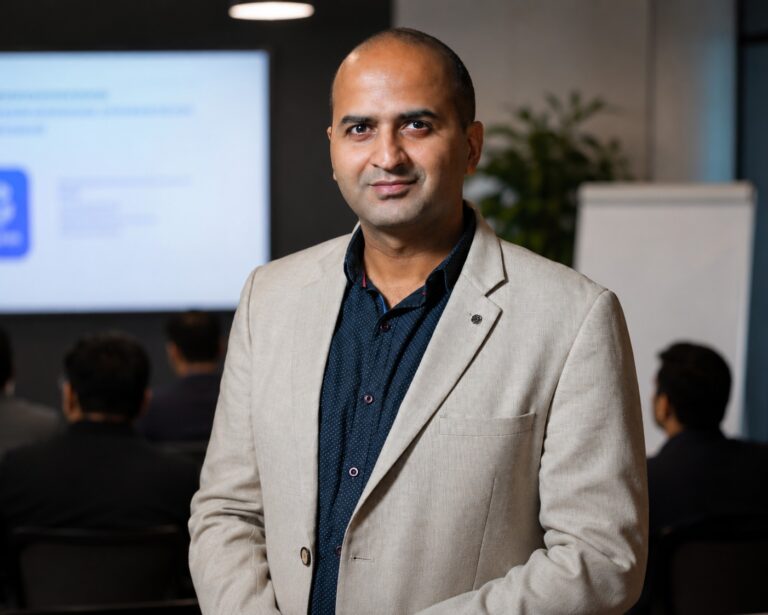
Why Hitesh Motwani
You leave with work done, not a pile of notes
Most AI courses show what Claude can do. Hitesh’s sessions have people doing their own work with it: the email they need to send today, the report due on Friday, the spreadsheet that takes a whole morning. They leave with workflows they use the next morning.
That is the point of the method. When the routine parts of a job take less time, people have more of it for judgement and relationships. The time saved repeats every week, and when a whole team works the same way, the organisation executes faster.
In the room
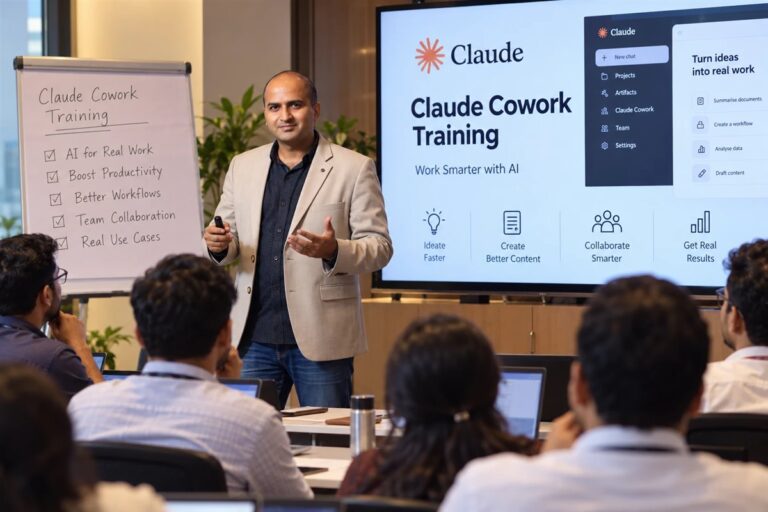
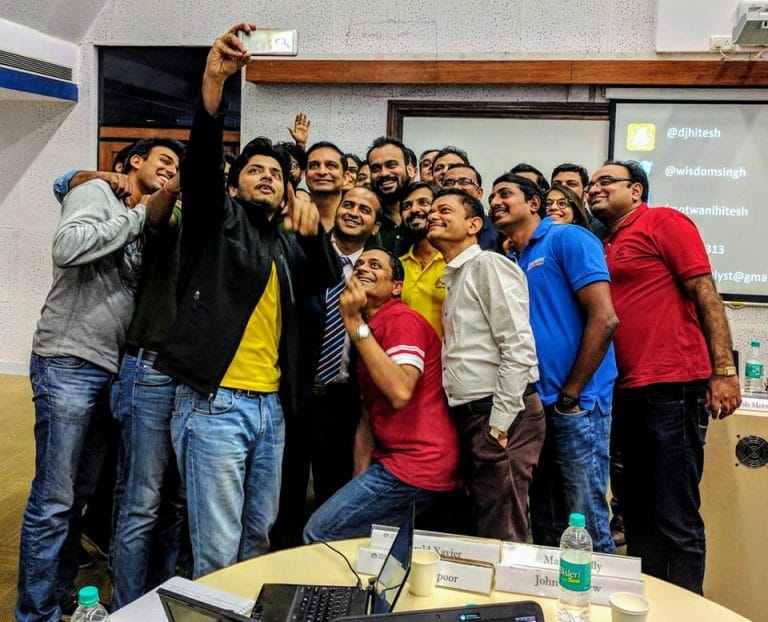
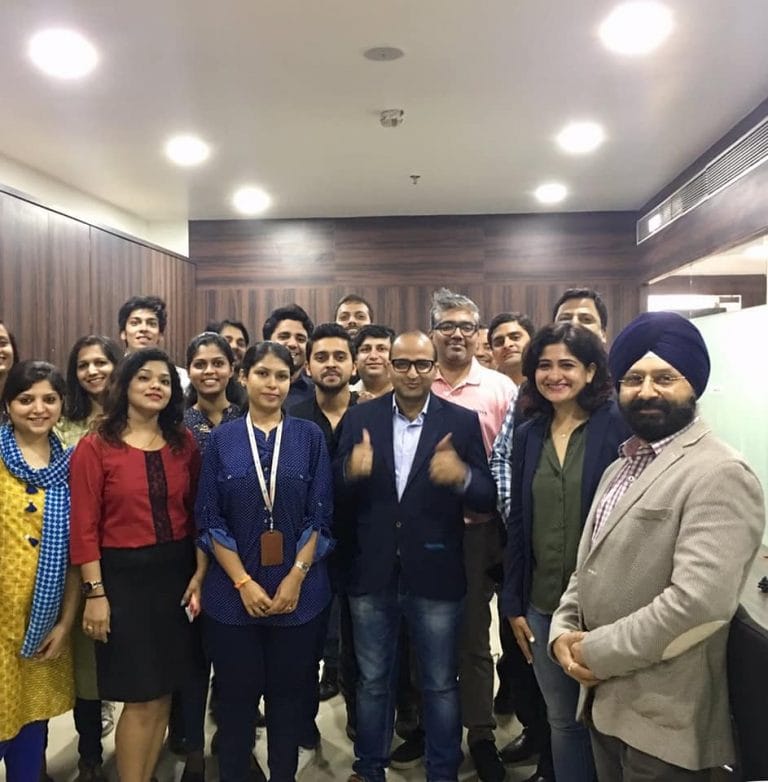
Hitesh with the people he trains

What participants say
Feedback from leaders who booked it
★★★★★
“Hitesh’s Claude AI session was the most practical AI training our leadership team has attended. They walked out with actual workflows they could use the next morning, not just slides.”
CEOTata Group subsidiary, Mumbai
★★★★★
“We had run three AI trainings before this. It was the first one where people were still using what they learned a quarter later, and the first where I had adoption numbers for my board deck.”
Chief Human Resources OfficerGlobal pharmaceutical company
★★★★★
“The Agentic AI and Connectors module blew our team’s minds. We had no idea Claude could be plugged into Slack and Salesforce to run entire workflows automatically.”
Head of Digital TransformationLeading BFSI company, Delhi NCR
How an engagement works
From first call to first session
1
Tell us the goal
Use the form or WhatsApp: who is learning, which Claude plan you use, and what should get faster.
2
Free scoping call
Agree the audience, track, format, dates and which data can be used in exercises.
3
Agenda and proposal
A written agenda built from your tasks, with the fee and logistics.
4
Hands-on sessions
Onsite in Hyderabad or live online. Participants keep everything they build.
5
Certificate and next steps
Skillopedia certificates, plus suggested follow-ups for the people and tasks that need them.
FAQ
Claude AI training in Hyderabad: common questions
Straight answers on fees, duration, format, certificates and the Claude plans you need.
Fees are quoted per engagement. They depend on the number of participants, whether the training is onsite in Hyderabad or online, and how many sessions you need. There is no fixed public batch fee. After a free call you receive a written proposal with the agenda, dates and fee. For 1-to-1 coaching, the fee is shared on the call.
For teams it runs as a leadership briefing, a half-day workshop, a full-day workshop or a multi-session programme spread over a few weeks. For individuals, 1-to-1 sessions are booked around your schedule and continue until you are confident with the tools your role needs.
Both. Companies get a private programme for their team. Individuals, including founders and senior leaders, learn through 1-to-1 coaching with Hitesh, live online. If you would rather join a structured group programme, ask on the call which current option fits you.
Both. Team sessions can run onsite at your office in HITEC City, Gachibowli, Madhapur, Kondapur, the Financial District or anywhere else in Hyderabad, or live online on Zoom or Microsoft Teams. Online sessions are live and hands-on, never pre-recorded.
Every participant receives a Skillopedia Claude AI Training certificate on completion, which is useful for LinkedIn, internal L&D records and appraisals. It is a training certificate from Skillopedia, not an Anthropic certification.
No coding is needed for the business track; the technical track expects comfort with Git and a terminal. The basics, including a limited number of Projects and Skills, work on Claude’s free plan. Claude Code, Research, Claude for Excel and the fuller agentic features need a paid plan such as Pro, Max, Team or Enterprise. Hitesh checks your plan on the scoping call and adapts the agenda to it.
Claude is Anthropic’s AI assistant, used in the browser, desktop and mobile apps for writing, analysis, research and files. Claude Code is the version for software work, running in your terminal or IDE on a real codebase. Claude Cowork was the mode for handing Claude multi-step tasks across your files and apps; Anthropic is now folding it into the main Claude experience. The course covers all three, depending on your track.
Yes, within your rules. The scoping call agrees which data can be used. Many teams use their own Claude Team or Enterprise workspace; others use sample or anonymised files. The course also teaches what should never go into any AI tool and how output is reviewed before it is used.
Yes. Track B covers Claude Code, MCP servers, the Claude API, agentic workflows and Claude Code on pull requests, practised on your own repositories. For a programme only for engineers, see the Claude Code training page.
Each participant needs a laptop, a Claude account on the plan you have chosen, and two or three real tasks from their job, such as a report, a spreadsheet, a document to rewrite or a piece of code. For onsite sessions you need a room with a screen and reliable Wi-Fi.
A recorded course shows generic examples. In a live session you work on your own tasks while Hitesh reviews your prompts and outputs, so you finish with real work done and a method you can repeat. A team also leaves with shared Projects and one way of working, which is what makes the whole organisation faster.
Yes. Hands-on groups are kept to about 15 to 20 people so everyone gets feedback. Larger teams are split into groups, usually by function or by track, and scheduled across days or weeks.
Hitesh Motwani, who has trained 200,000+ professionals across 16+ countries for clients including Google, Microsoft and Tata Group. He is the author of Generative AI 360°, has 17+ years in training, and is visiting faculty at K J Somaiya Institute of Management. His work covers LLMs, AI agents, prompt engineering and automation, including leadership AI training for founders and CXOs.
Start here
Make Claude part of how your Hyderabad team works
Tell Hitesh who the training is for and what should get faster. You will get a suggested plan, format and fee for your team, or for yourself.
Call or WhatsApp +91 98924 14313
Book a free call
Pick a time that suits you
A free, no-obligation call with Hitesh to talk through your team or your own goals.
Calendar not loading? Open the booking page.
Send an enquiry
Prefer to write? Send the details here
Hitesh replies personally. For a quicker answer, WhatsApp +91 98924 14313.
Related training